


SoveHush™ – The Calming Sound Bowl for Dogs
SoveHush™ – The Calming Sound Bowl for Dogs
He's not barking at nothing. He's hearing frequencies you can't.
SoveHush plays soft, steady sound frequencies (396–963 Hz) that fill the room.
- Why he barks. His ears pick up frequencies far above your range. In a silent room, every one of them can set off his alarm.
- How SoveHush works. One soft, steady frequency fills the silence, so sudden noises stand out less. That's called sound masking.
- What research shows. In published studies, shelter dogs played calming sound barked less and spent more time lying down.*
- No shock, no spray, nothing to swallow. One button, plays for hours.
*Those studies used calming music in shelter kennels, not SoveHush. Results vary. See the studies
Choose Your Bundle
 x1
1 SoveHush FREE SHIPPINGOne room · Save 39%
$69.99$114.00
One room. One calm signal. Starting today.
Most Popular x2
x22 SoveHushes FREE SHIPPING2 bowls · Total $119.99 · Save 47%
$60.00 /bowl$114.00 /bowl
One for home, one for the car or crate.
Best Value x3
x33 SoveHushes FREE SHIPPING3 bowls · Total $149.99 · Save 56%
$50.00 /bowl$114.00 /bowl
Living room, bedroom and crate. Or one for the dog sitter.
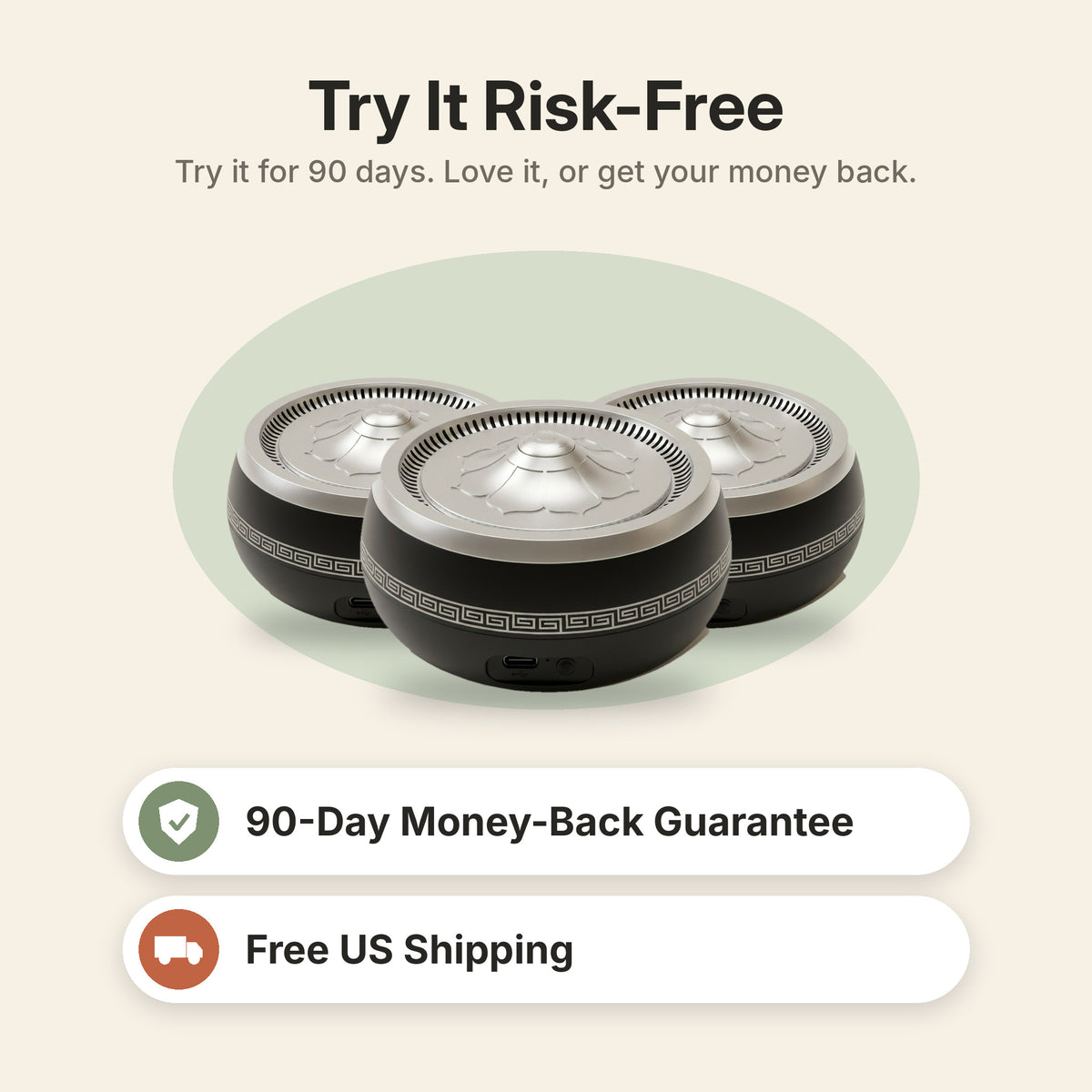
🚚 Free US shipping on every bundle · 🐾 90-day money-back guarantee
Couldn't load pickup availability
- Visa payment method
- Master payment method
- American express payment method
- Apple pay payment method
- Google pay payment method
What To Expect, Week By Week
No made-up reviews. Just the honest timeline — and 90 days to judge it on your own dog.
Every dog is different. Results vary.
SoveHush™ – The Calming Sound Bowl for Dogs. One button, 8 soft singing-bowl tones, timer or continuous play. A steady sound designed to help your dog settle at his trigger moments: the doorbell, when you leave, storms and restless evenings. No shock, no spray, no ultrasound. USB-C rechargeable (about 10 hours), carry pouch included. Free US shipping and a 90-day money-back guarantee.
That's exactly who it's for. Not the dog who barks at the mail carrier once a week — the one who goes off at the doorbell, the window, the hallway, the trash truck, and takes twenty minutes to come down. If you've started apologizing to the neighbors, dreading the delivery van, or feeling sick every time you leave for work, you're the owner we built this for.
A dog who barks "at nothing" is on guard. Every car door and footstep in the hall is something he has to report — we call it the Always-On Alarm. SoveHush fills the room with one soft, steady tone that covers those little trigger noises and becomes his cue to lie down. Research on shelter dogs found calming music meant more time lying down and quiet. Those studies used music in kennels, not SoveHush — and we're not going to pretend otherwise. That's why you get 90 days to judge it on your own dog.
No, and you wouldn't want it to. The bark that tells you someone's at the door is your dog doing his job. What SoveHush is designed for is the other kind — the spiral that starts at nothing and won't switch off. Keep the useful bark. Turn down the one that's costing you both.
Because every one of those misses the alarm. A shock or spray collar punishes a dog who's already scared — the bark stops for a second, the alarm stays on. Calming treats can take 30 to 60 minutes and then wear off. The TV throws new voices, sirens and volume jumps at him all day. SoveHush is one steady sound, nothing on his neck, nothing to swallow. Press the button and get on with your day.
Used as directed, yes. No ultrasound, no shock, no spray — just soft, audible tones you can hear too. Keep the volume low, about as loud as soft rain, place it around 6 ft (2 m) from his bed, never right next to his head, and make sure he can always leave the room. If he ever seems uncomfortable, turn it off.
On a shelf or table about 6 ft from his bed or crate. Pick one of the 8 tones and use it at his trigger moments: before you leave, during delivery hours, before a storm, at the evening wind-down. Set the timer (15 to 60 minutes) or let it play continuously — one charge lasts about 10 hours. Dogs get used to any sound, so key moments beat 24/7, and switching tones now and then helps.
Free tracked US shipping on every bundle. Orders leave our warehouse within 24 to 48 business hours and your tracking link arrives by email. In the box: 1, 2 or 3 SoveHush sound bowls (depending on your bundle), a USB-C charging cable and a carry pouch for the car, the crate or the dog sitter. Package arrived damaged? Message us and we'll reship it.
Then you get your money back. 90 days from delivery. No questions. Every cent refunded to your original payment method. We'd rather refund you than have you keep something that didn't help. Press play, watch your dog, decide at the end — the only thing you can lose is the barking.
View full details


What No One Tells You About A Barking Dog

He's Not Being Bad. His Alarm Just Won't Switch Off.
The doorbell rings and you're already bracing. A car door slams outside and you know exactly how the next ten minutes sound. You've found the note taped to your door. You've smiled at the neighbor in the hallway and watched her not smile back. You've read the landlord's email twice. You've built your whole day around a sound you can't switch off.
And every morning you grab your keys and feel sick, because you know what the next eight hours sound like for him. The shredded cushion. The scratched door frame. The Fourth of July night on the bathroom floor with him shaking in your arms. You've yelled. You've felt awful about yelling. You are not a bad owner, and he is not doing it to spite you. He's on guard. His Always-On Alarm never shuts off — and every little noise is a threat he has to report.
Stop trying to shut him up.
Start turning his alarm down.
Shock collars punish a dog who's already scared — the bark stops for a second, the alarm stays on. Sprays only fire once he's already gone. Calming treats can take an hour to kick in, then wear off. And the TV you leave on? New voices, sirens and volume jumps all day long. More triggers, not fewer. SoveHush takes the other end of the problem. One button fills the room with a soft, steady tone that covers the little noises that set him off and tells him: all clear, you can lie down now. It plays for hours. Nothing on his neck. Nothing to swallow. Nothing that punishes him.
01Nothing Shocks, Nothing Punishes
02One Button. Plays For Hours.
03He Keeps His Happy Bark
No shock collar. No spray. No pills. No TV.
One button. One steady tone. Ninety days to decide.
Turn it on at his trigger moments and watch him, not the clock. The delivery that comes and goes without the full performance. The walk to your car without the howling behind the door. The storm he rides out on his bed instead of under the table. The evening he lies down instead of pacing the window. The same dog — just not on high alert over every little thing.
SoveHush is a calming sound device for the home. It is not a veterinary medical device, not a substitute for training, and not a treatment for separation anxiety, aggression or any diagnosed condition — serious cases should be worked on with your veterinarian or a certified animal behaviorist. Individual results vary.
He isn't barking at you. He's barking because nothing in his day tells him it's safe to stop. SoveHush doesn't silence your dog — it gives his alarm a reason to stand down.
4 Moments SoveHush Was Made For.One Button. One Steady Tone.
The doorbell, the minute you leave, the storm, the evening that never winds down — SoveHush doesn't silence your dog. It covers what sets him off.
 01
The Doorbell
A Delivery Comes And Goes
The van pulls up. You brace out of habit. With the steady tone already filling the room, there's less for him to react to — and you realize you've been holding your breath over nothing.
 02
You Leave
The Sound Stays When You Go
Press the button before you grab your keys. The room keeps the same calm sound it had while you were there — instead of eight hours of silence broken by every footstep in the hall.
 03
The Storm
A Softer Backdrop To The Bangs
Turn it on before the thunder rolls in, or before the Fourth of July starts. A constant tone in the room softens the gap between silence and the next crack outside.
 04
The Evening
He Settles Instead Of Pacing
No circling the window. No reacting to every car in the street. One soft tone, the same one every night, becomes his cue that the day is done.
What this is: SoveHush is a calming sound device for the home. It is not a veterinary medical device, not a substitute for training, and not a treatment for separation anxiety, aggression or any diagnosed condition. Serious cases should be worked on with your veterinarian or a certified animal behaviorist. Individual results vary.
Backed By Science
What Research Says About Sound And Stressed Dogs.
Studies show calming sound can reduce barking and stress behaviors in dogs. Here's exactly what researchers did, what they saw, and where to read it yourself.
What they did
Shelter dogs, 7 days of classical music
Researchers played a classical music playlist into the kennels of a Scottish SPCA rescue center for a week, and compared it with a week of silence.
What they saw
On the first day of music, the dogs spent more time sitting, lying down and quiet, and less time barking. Their heart rate variability (a stress indicator) improved. The effect faded within the week as the dogs got used to the same playlist.
Bowman A., Dowell F.J., Evans N.P. (2015). "'Four Seasons' in an animal rescue centre; classical music reduces environmental stress in kennelled dogs." Physiology & Behavior, 143, 70–82. doi.org/10.1016/j.physbeh.2015.02.035
What they did
117 shelter dogs, 3 kinds of music
Researchers played classical music, heavy metal and a specially altered classical track to 117 kennelled dogs, and compared them with no music.
What they saw
With classical music, the dogs spent more time sleeping and less time vocalizing than with the other music or with silence. Heavy metal did the opposite: more body shaking.
Kogan L.R., Schoenfeld-Tacher R., Simon A.A. (2012). "Behavioral effects of auditory stimulation on kenneled dogs." Journal of Veterinary Behavior, 7(5), 268–275. doi.org/10.1016/j.jveb.2011.11.002
What they did
38 shelter dogs, 5 music genres
The same Scottish team played soft rock, Motown, pop, reggae and classical music to 38 kennelled dogs over 5 days.
What they saw
Whatever the genre, the dogs spent more time lying down and less time standing while music played, and their heart rate variability improved most with soft rock and reggae. Barking did not drop during the music in this study. The effects held over the 5 days, and the authors suggest that varying the music may help dogs not get used to it.
Bowman A., Scottish SPCA, Dowell F.J., Evans N.P. (2017). "The effect of different genres of music on the stress levels of kennelled dogs." Physiology & Behavior, 171, 207–215. doi.org/10.1016/j.physbeh.2017.01.024
What they did
A review of the research
A team of researchers reviewed the published studies on sound and music for dogs.
What they saw
Their conclusion: classical music appears to have a calming influence on dogs in stressful environments. They also note that dogs can get used to the same sounds, and that the field still needs more research.
Lindig A.M., McGreevy P.D., Crean A.J. (2020). "Musical Dogs: A Review of the Influence of Auditory Enrichment on Canine Health and Behavior." Animals, 10(1), 127. doi.org/10.3390/ani10010127
Straight Talk · What These Studies Are And Aren't
These studies tested calming music played to dogs in shelter kennels. SoveHush applies the same principle — a soft, steady sound in the room — at home. SoveHush itself has not been tested in a clinical study. Dogs can get used to any sound, so use it at his trigger moments and switch tones now and then. And if it doesn't work for your dog, you get every cent back.
Stop The Barking Spiral In 90 Days
Or Every Cent Back
Your order is protected by our 90-day, 100% money-back guarantee. Put SoveHush on a shelf near his bed, press the button at the moments that set him off, and pay attention to the ones you've learned to dread.
The doorbell. The delivery van. The minute you leave for work. The storm. The evening he paces the window instead of settling. Watch whether those go the way they always do, or whether the house gets quieter than it's been in months.
If nothing shifts, if it isn't right for your dog, or if you're simply not satisfied, contact us within 90 days of delivery and get a full refund.
No video evidence, no behavior logs, no lengthy forms. You only need to decide whether SoveHush stays on the shelf or comes back to us.
Ninety days to decide. The only thing you can lose is the barking. Our support team is here if you need help with your order, delivery or guarantee.
Frequently Asked Questions
Questions Owners Ask Before Trying SoveHush
Straight answers about the sound, his ears, what to expect, and what we're not going to pretend it does.
My dog barks at everything. Is this really for us?
That's exactly who it's for. Not the dog who barks at the mail carrier once a week — the one who goes off at the doorbell, the window, the hallway, the trash truck, and takes twenty minutes to come down.
If you've found a note on your door, dread every delivery, or feel sick each time you leave him alone, you're the owner we built this for.
How does a sound actually calm a dog?
A dog who barks "at nothing" isn't stubborn — he's on guard. His Always-On Alarm treats every car door and footstep in the hall as a threat he has to report.
SoveHush fills the room with one soft, steady tone. It covers the little noises that set him off, and used at the same moments every day, it becomes his cue that it's safe to lie down.
Research on shelter dogs found that calming music meant more time lying down and quiet (see the studies above). Those studies used music in kennels, not SoveHush, and we're not going to invent a trial we didn't run. That's why you get 90 days to judge it on your own dog.
Will it stop him barking completely?
No, and you wouldn't want it to. The bark that tells you someone's at the door is your dog doing his job.
What SoveHush is designed for is the other kind — the spiral that starts at nothing and won't switch off. Keep the useful bark. Turn down the one that's costing you both.
I've tried a bark collar, calming treats, even leaving the TV on. Why would this be different?
Because every one of those misses the alarm. A shock or spray collar punishes a dog who's already scared, which adds stress to a dog who's full of it. Calming treats can take 30 to 60 minutes and then wear off. The TV throws new voices, sirens and volume jumps at him all day.
SoveHush is one steady sound, the same every time. Nothing on his neck, nothing to swallow, no routine to keep up. Press the button and get on with your day.
Is it safe for his ears? What about cats and other pets?
Used as directed, yes. No ultrasound, no shock, no spray — just soft, audible tones you can hear too.
Keep the volume low, about as loud as soft rain. Place it around 6 ft (2 m) from his bed, never right next to his head, and make sure every pet can leave the room if it wants to. If your dog ever seems uncomfortable, turn it off.
Where should I put it, and when should I use it?
On a shelf or table about 6 ft from his bed or crate. Pick one of the 8 tones and use it at his trigger moments:
- Before you leave for work
- During doorbell and delivery hours
- Before a storm or fireworks
- At the evening wind-down
Dogs can get used to any sound, so key moments beat 24/7 — and switching tones now and then helps keep it meaningful.
Can it play while I'm at work all day?
Yes. Set the timer from 15 to 60 minutes, or let it play continuously. One USB-C charge lasts about 10 hours.
Start it a few minutes before you grab your keys, so the room already sounds calm when the door closes behind you.
Which bundle should I choose?
One room? One SoveHush. The 2-pack is our most popular: $60.00 per bowl, one for home and one for the car or crate.
The 3-pack ($50.00 per bowl) covers the living room, bedroom and crate — or one for the dog sitter. Free US shipping on every bundle.
How long before I notice anything?
We're not going to give you a number, because we'd be making it up and you'd hold us to it.
- Use the same tone at the same moments, every day
- Judge on the pattern over weeks, not on one bad evening
- Keep doing whatever training already helps — this sits alongside it
Some dogs settle the first evening. Others need a couple of weeks to learn the cue. Results vary — that's what the 90 days are for.
Is SoveHush a medical or behavioral treatment?
No. SoveHush is a calming sound device for the home.
It is not a veterinary medical device, not a substitute for training, and not a treatment for any diagnosed condition. If your dog hurts himself, destroys doors or crates, or shows aggression, please see your veterinarian or a certified animal behaviorist. Severe anxiety deserves real professional help.
What if nothing changes?
Then you get your money back. 90 days from delivery. No questions. Every cent refunded to your original payment method.
No video evidence, no behavior logs, no lengthy forms. We'd rather refund you than have you keep something that didn't help your dog.
Press play, watch your dog, decide at the end. The only thing you can lose is the barking.
SoveHush is a calming sound device for the home. It is not a veterinary medical device and is not intended to diagnose, treat, cure or prevent any condition. Results vary from dog to dog. The studies cited on this page tested calming music played to kenneled dogs, not this product. For severe separation anxiety, self-injury or aggression, talk to your veterinarian or a certified animal behaviorist. Use at low volume, a few feet away from his bed, and make sure your dog can leave the room. Stop using it if he shows any sign of discomfort.